
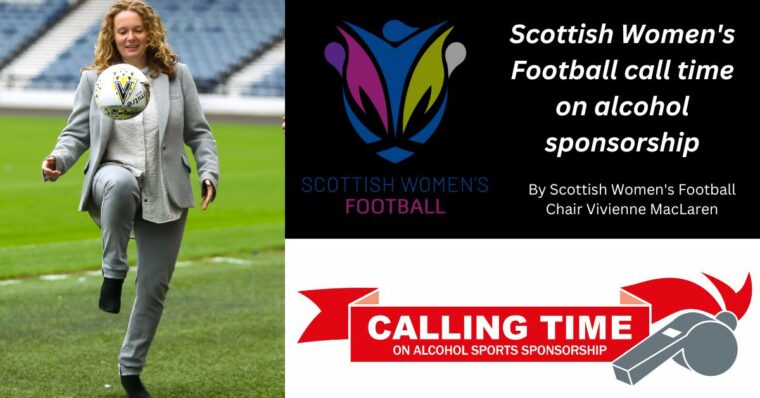
By Vivienne MacLaren, Chair of Scottish Women’s Football.
In this blog, Vivienne MacLaren talks about SWF’s commitment to reject alcohol sponsorship, their partnership with SHAAP and the importance of the Calling Time campaign.
It has been fascinating to follow the progress of SHAAP’s Calling Time campaign from the perspective of an organisation that has already adopted the position to reject alcohol industry sponsorship. The recent Scotland-wide poll by The Alcohol Toolkit Study suggests that there is a greater awareness of the impact of alcohol promotion among the public than there is among sporting bodies.
Scottish Women’s Football linked up with Scottish Health Action on Alcohol Problems in 2019 to raise further awareness as part of the performance pathway for elite players within our youth game.
For us, it was about recognising our responsibility for playing a positive role in the wellbeing of players, especially with the exponential growth in the youth game. We found that such a partnership allows us to promote positive messages around the health and wellbeing of young people.
Clearly, attaching our leagues to an alcohol brand would give out mixed signals at best, if not place harmful products into the hands of those we have a duty to look out for.
Last year, we were delighted that SHAAP continued to support our elite youth game, which has now been rebranded the National Academy Programme (NAP) and features the top clubs in Scottish Women’s Football, including: Glasgow City, Hibernian, Celtic and Rangers.
This programme nurtures the next generation of talent, and we hope that such a partnership allows us to support these young people to be healthy and well and make the best decisions as they rise to the top. The NAP seeks to develop the potential of players in our youth performance leagues and aims to support the wider network of coaches and staff, and it’s important for us to lead by example.
Not only does this reflect our responsibilities for the health and wellbeing of all participants in the sport, it also acknowledges the links that physical activity has with good health outcomes including reduced risk of disease and improved mental health. It is widely acknowledged that alcohol has a negative impact on both.
As well as positive messages around their health and wellbeing, this clearly would be undermined by commercial revenue from alcohol brands elsewhere in the women’s game.
We take the health and welfare of our players extremely seriously, and I’m proud of our stance when it comes to avoiding sponsorship from alcohol or gambling brands.
But there is another angle to this as well. There is a narrative that alcohol and gambling brands are the big spenders, that sport would suffer without them. I’m not so sure. On top of our evident social responsibility that comes from not promoting harmful products, SWF feel our stance has been financially justified and supported by the sponsors we have attracted to the game in recent years. It has helped the image of the sport, rather than hindered it.
It has also been stated that alcohol and gambling brands are the only ones that have cash to invest in the game. I think the reality is that many other organisations are put off investing due to the huge numbers of alcohol and gambling brands already there.
Women’s Football is growing rapidly, further boosted in no small part by England’s Lionesses success at the European Championships last year. It’s important that it grows on its own merits and isn’t seen as an extension or little sister of the men’s game. Scottish Women’s Football is growing the game in Scotland from the grassroots up and we have attracted interest from high profile sponsors like Biffa for our regional competitions. Part of that is because we have dared to be different.
SHAAP Blogposts are published with the permission of the authors. The views expressed are solely the authors’ own and do not necessarily represent the views of Scottish Health Action on Alcohol Problems (SHAAP).