By Dr Alastair MacGilchrist, SHAAP Chair and former Consultant Hepatologist at the Royal Infirmary of Edinburgh.
In this blog, Dr MacGilchrist looks back at SHAAP’s work in 2022, including report launches, Parliamentary events and SHAAP’s first public-facing campaign, calling time on alcohol sponsorship in sports. Dr MacGilchrist also discusses SHAAP’s plans for the year ahead, including our continued work to support Minimum Unit Pricing in Scotland.
January gets its name from Janus the Roman god of transitions who is depicted with two faces, one looking backwards and one forwards. In this blog, I will reflect on what we at Scottish Health Action on Alcohol Health Problems (SHAAP) have been doing over the past year and our plans for the year to come.
The year past…
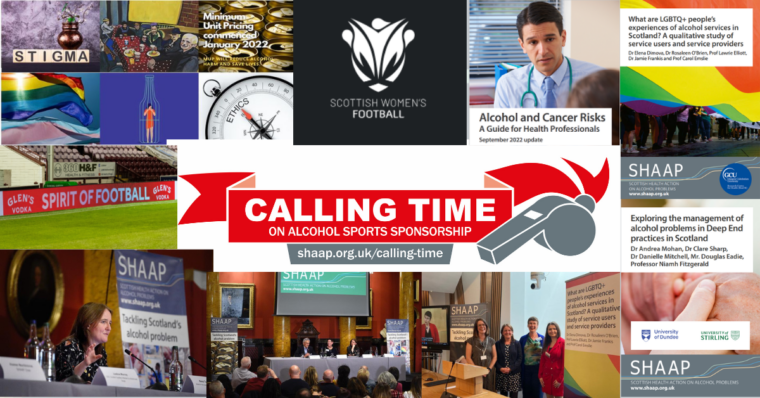
2022 saw the publication of 3 SHAAP reports. The first was a study by Professor Carol Emslie’s team at Glasgow Caledonian University, examining how LGBTQ+ communities experience alcohol treatment services. Dr Elena Dimova found that these communities face real barriers in accessing alcohol treatment services, and made useful recommendations on reducing these. The work was well-received when launched via an event at Holyrood and had a significant political impact, triggering a debate in the Scottish Parliament. The discussions also shone a light on why LGBTQ+ people are more prone to alcohol problems.
The second was a study by Professor Niamh Fitzgerald’s team at the University of Stirling which evaluated the use of alcohol nurses in ‘Deep End’ GP practices in deprived communities in Glasgow. Dr Andrea Mohan found that the Primary Care Alcohol Nurse Outreach Service (PCANOS) was a good example of a patient-centred model of collaborative working which was in general well-received by patients and primary care staff. A subsequent full evaluation of the PCANOS project confirmed that in such deprived communities, embedding an alcohol nurse in GP practices was highly effective, reducing GP attendances, A&E attendances and hospital admissions.
The third report concerned alcohol sponsorship of football. Drs Nathan Critchlow and Richard Purves from the University of Stirling studied the extent of alcohol sponsorship of football in different European countries. They found that across European football leagues, Scotland has the second highest number of alcohol sponsors, and that there was minimal alcohol sponsorship in those countries with legal restrictions on alcohol marketing.
This study coincided with the launch of SHAAP’s ‘Calling Time’ campaign to ban alcohol sponsorship of sport in Scotland. The Scottish Government are currently consulting on proposals to place legal restrictions on alcohol marketing, which SHAAP strongly support, given the evidence that such restrictions are one of the most effective measures to reduce alcohol harm. A 3 day exhibition in the Scottish Parliament to promote our Calling Time campaign generated support across all political parties and even garnered early support from former First Minister of Scotland, Rt Hon. Henry McLeish. SHAAP continues its partnership with Scottish Women’s Football (SWF), which will not accept any alcohol sponsorship as part of its commitment to promote a healthy and active lifestyle. In 2022, SHAAP renewed its sponsorship of SWF’s National Academy Programme, its competitive league for elite youth players.
SHAAP had 2 further publications of note in 2022. We updated our guidance for health professionals on Alcohol and Cancer, which received wide international coverage. Our guidance for heavy drinkers wishing to cut down, initially issued in response to the first Covid lockdown, has been amended in 2022 for general applicability and made more widely available to GPs and hospital clinics.
SHAAP remains committed to supporting and disseminating research aimed at reducing alcohol harm. The Scottish Alcohol Research Network (SARN), hosted by SHAAP, held 4 ‘Alcohol Occasional’ seminars in 2022. The online nature of these seminars has greatly widened the audience and all are available online. SHAAP were co-hosts of the INEBRIA international conference in Edinburgh examining the latest worldwide research into alcohol brief interventions, and took the opportunity to hold a Question Time style event on alcohol policy in Scotland which generated widespread interest.
Recognising the importance of stigma as a barrier to alcohol treatment, I as SHAAP Chair recorded an interview which forms part of the Reporting of Substance Media toolkit, a resource developed by Scottish Families Against Alcohol and Drugs (SFAD) for journalists and editors wishing to report on alcohol and drugs with dignity and respect.
The year ahead…
Looking ahead to 2023, Scotland finds itself facing a rising number of deaths from alcohol. The 1245 alcohol-specific deaths in 2021 represents a 22% increase since 2019. This coincides with the Covid pandemic which adversely affected our drinking patterns, with heavy drinkers increasing their consumption. We are also facing unparalleled pressures on the NHS, an economic recession and a rising cost of living. One might be tempted to think these immediate crises should put alcohol policy on the back burner, but in fact nothing could be further from the truth, and it is more important than ever that the UK and Scottish Governments take action to reduce alcohol harm. The health consequences of alcohol are one of the largest burdens on our health service, with an estimated 1 in 5 hospital in-patients drinking at harmful levels, and 1 in 10 being alcohol-dependent, therefore tackling Scotland’s alcohol problem will help to alleviate those NHS pressures. Alcohol costs our economy billions every year (estimated at £3.6 billion in 2007) so tackling alcohol harm will also help alleviate economic pressures. Alcohol harm disproportionately affects the poorest in our society, so reducing alcohol harm will especially protect those in the most deprived communities – tackling alcohol harm should be central to any ‘levelling up’ agenda. Doing nothing is certainly not an option: modelling suggests that if the drinking patterns developed during Covid persist, the consequences for our health, and our health service, will be catastrophic.
One of the most effective measures to reduce alcohol harm is to reduce its affordability. The Minimum Unit Price (MUP) for alcohol, which came into effect in Scotland in 2018, is currently being evaluated ahead of a decision by the Scottish Parliament before May 2024 as to whether it should remain, and if so at what level. Some have suggested that the rise in alcohol deaths is evidence that MUP has ‘failed’. However, this does not take into account the confounding effect of the Covid pandemic. The evidence is strong that MUP has caused a reduction in alcohol consumption, as intended. In the brief window after the introduction of MUP and before the Covid pandemic, alcohol deaths fell, reversing a steady upward trend over the previous years. England does not have an MUP, and the increase in deaths across the whole of the UK over the past 2 years was 28% compared to 22% in Scotland – suggesting that MUP may be exerting a mitigating effect. However, the impact of MUP on reducing alcohol harm is dependent on the level at which it is set, and the current 50p level – first proposed over a decade ago – is now too low to have a major impact, particularly with the current high level of inflation. During 2023, SHAAP will continue to make a strong case for MUP to continue at an uprated level.
SHAAP will continue our ‘Calling Time’ campaign to ban alcohol sports sponsorship and will respond to the Scottish Government’s consultation with a strong case for widespread restrictions on alcohol advertising.
SHAAP are supporting the Scottish Government’s work to improve alcohol treatment services. One of our Steering Group members is chairing the Government’s Alcohol Brief Interventions (ABI) Programme Board which is intended to review and refresh the ABI programme in Scotland, which has stalled in recent years. Another is chairing the Alcohol Treatment Target Group looking at how to incentivise a much-needed improvement in alcohol treatment services, which in recent years have suffered cuts just when the demand has been increasing. The renewed focus on alcohol services which these reviews demonstrate is welcome, but should not obscure the urgent need for increased capacity for such services.
SHAAP have commissioned an in-depth survey of hospital alcohol services, focussed on alcohol-related liver disease. This work will be completed in early 2023 and will be used to help local health boards improve their alcohol services in secondary care.
SHAAP are working with the Royal College of General Practitioners to improve the knowledge of alcohol harm in primary care.
SHAAP are also considering the problems and opportunities for alcohol treatment in the criminal justice setting. Having completed an extensive scoping exercise in 2022, we will be bringing all stakeholders together in an important knowledge-sharing event in 2023.
So, as 2022 turns into 2023, SHAAP is working on many fronts to tackle Scotland’s on-going alcohol problem. The work goes on!
SHAAP Blogposts are published with the permission of the authors. The views expressed are solely the authors’ own and do not necessarily represent the views of Scottish Health Action on Alcohol Problems (SHAAP).