
In our latest blog, Josh D shares his lived experience of alcoholism and recovery to highlight the importance of recognising Alcoholics Anonymous (AA) as a means of support for those with alcohol problems within the Justice System.
For fourteen years, my life centred on alcoholism, drug addiction, family estrangement, homelessness, repeated prison sentences and multiple stints in residential rehab. Caught in a cycle of self-destruction, I saw no viable way out. Then, after my third stay in rehab, I was introduced to Alcoholics Anonymous (AA). Through the 12 Steps, shared experiences and genuine fellowship, I found sobriety, and a new way of living.
I am now a PhD candidate and a senior researcher, having gained two degrees, a mortgage, a supportive partnership and two daughters. I primarily credit AA with helping me rebuild my life, surrounding me with people who truly understood how to start again from scratch.
Why finding the right support matters
High rates of drug and alcohol use by people who end up in custodial environments often stem from trauma, social exclusion and unresolved addictions. Restrictive regimes may fail to address these complex issues, leading to cycles of reoffending. AA offers an evidence-based, peer-led approach that promotes accountability, self-reflection and mutual support. A 2020 Cochrane review (Kelly et al., 2020) found AA programmes to be at least as effective as other treatments in reducing alcohol use and improving mental wellbeing, and more effective than alternatives in sustaining continuous abstinence.
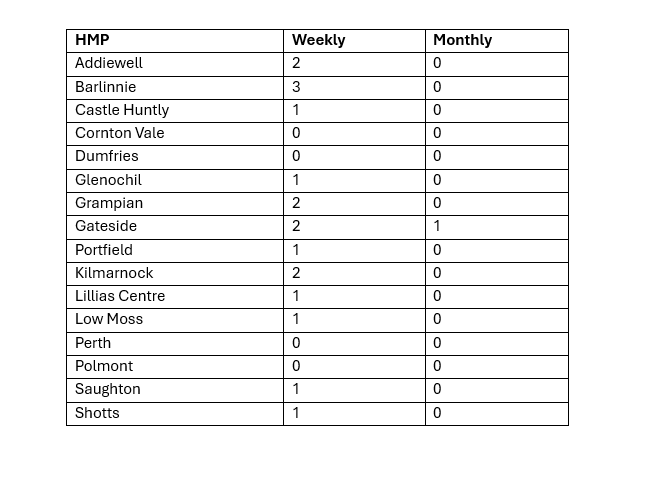
Table 1: AA activity across Scottish prisons
Table 1 highlights the ongoing efforts of AA across Scottish prisons. In general, we find that where attendees have consistent access to meetings, reports suggest reduced cravings, stronger coping strategies and improved engagement with other rehabilitative programmes. Participants who continue AA after release credit it with helping them secure employment, rebuild family relationships and remain sober in the community.
Case studies: Consistent meetings and tangible outcomes
In one custodial setting, two weekly AA meetings attract between ten and twenty attendees each. Over time, seven individuals have completed the 12 Steps, found sponsors and now serve as peer mentors, helping newcomers engage in recovery. Another facility holds a well-attended weekly session supported by AA speakers, with participants gradually opening up, discussing personal challenges and setting recovery goals.
In both environments, a number of individuals who left custody maintain sobriety by connecting with AA on the outside, some are now employed full-time, while others share their experiences publicly to support others with substance use issues. One individual, who had been repeatedly imprisoned over decades, has remained sober for over a year and now works for a peer-led service helping others upon release. These examples illustrate how consistent AA provision can reduce recidivism, foster emotional growth and empower individuals to pursue a meaningful future.
However, staffing shortfalls have caused cancellations. In one case, three out of five planned meetings were called off in a single month. Soon afterwards, several participants relapsed, one requiring medical attention for an overdose. Though anecdotal, this highlights how vital recovery support can be in a high-risk environment.
Extending reach: print, radio and digital solutions
To address unequal access, AA has introduced a newsletter, Beyond the Bars, featuring personal letters from those already engaged with the 12 Steps while inside. Even in establishments with limited in-person provision, this newsletter offers insight and encouragement, helping maintain momentum for those considering recovery.
Some facilities have also broadcast AA content via internal radio systems, ensuring that individuals in restrictive regimes or remote units can still hear messages of hope and practical guidance. Digital tools, including secure video calls or recorded talks, can expand AA’s impact further by allowing participants to continue attending meetings when transfers or lockdowns disrupt standard routines.
Building stronger partnerships
AA’s Criminal Justice Subcommittee is currently mapping out existing provision and exploring ways to collaborate with service providers working on new drug and alcohol strategies. By working in closer partnership, the Scottish Prison Service, social work, and community-based agencies can create seamless pathways that span pre-custody, in-custody and post-liberation stages. AA could be a key partner in this, along with other recovery organisations.
A watermarked ‘chit’ system allows AA attendees to evidence their participation, which can be shown to social work teams, courts or other relevant bodies. This is especially valuable for individuals on bail or community orders, offering a tangible record of commitment to recovery. Elsewhere, such as parts of England, Canada and Australia, AA enjoys well-recognised partnerships with courts, probation and parole. Here in Scotland, AA works well with the Glasgow Alcohol Court, supporting people on community sentences. Scotland can adapt these models and build on the Glasgow Alcohol Court approach to promote a more consistent, recovery-focused approach across the entire justice system.
A call to action
Expanding AA’s footprint within Scottish justice settings is a cost-effective way to reduce reoffending, strengthen mental health outcomes and limit the strain on broader public services. The Cochrane evidence, combined with real-life successes, confirms that AA can transform lives, if given the right support and integration.
Organisations such as Scottish Health Action on Alcohol Problems (SHAAP) can help champion this vision, influencing policy to recognise AA as a mainstream service alongside other recovery communities and service providers. AA could also function as a diversionary option for individuals facing alcohol-related charges. With structured collaboration, incorporating face-to-face meetings, print resources and digital access, Scotland can develop a more recovery-oriented system that reaches anyone seeking a second chance.
My own journey, from chaotic substance use to a life anchored in stability and purpose, reflects AA’s power to reshape destinies. By embedding it more fully within Scotland’s criminal justice framework, we can offer that same hope to many more, one day at a time.
References
- Kelly, J.F., Humphreys, K. & Ferri, M. (2020). Alcoholics Anonymous and other 12-step programs for alcohol use disorder. Cochrane Database of Systematic Reviews, Issue 3. Art. No.: CD012880.
SHAAP Blogposts are published with the permission of the authors. The views expressed are solely the authors’ own and do not necessarily represent the views of Scottish Health Action on Alcohol Problems (SHAAP).