
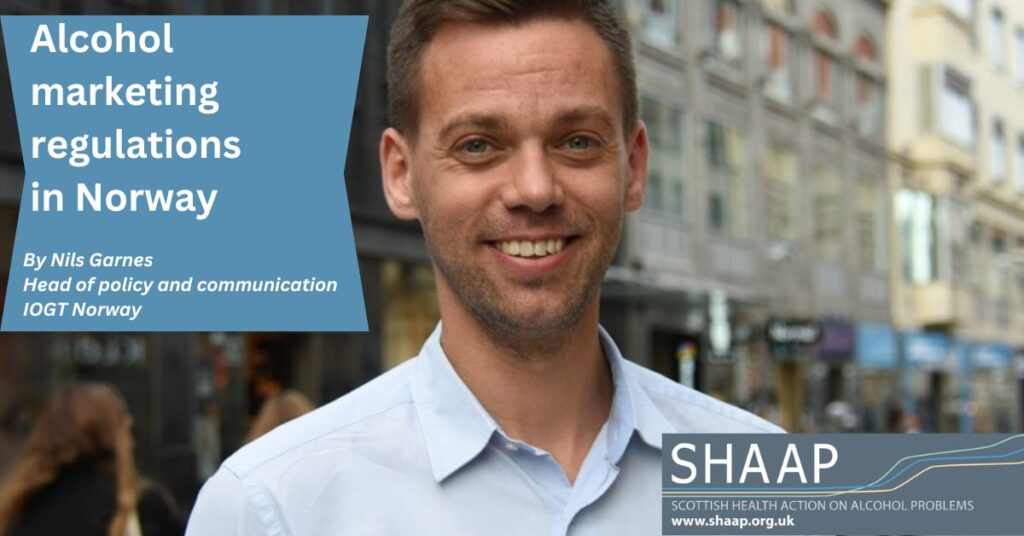
Nils Garnes, the Head of policy and communications at IOGT Norway, writes about the success of alcohol marketing regulations in Norway and how these differ from those currently in place in the U.K.
Comparing Norway and the United Kingdom on alcohol marketing regulations
Alcohol is strictly regulated in Norway, and exposure to alcohol brands and promotions is not allowed, even on social media. I would argue that this approach has been a success and should set an example for other countries that would like to minimize exposure from alcohol brands and marketing.
After six years living in Belgium and the UK, I was used to alcohol advertisements in streets and stations, sports events, in traditional media, as well as social media and webpages. This changed when I moved back to Norway.
Regulations in Norway on alcohol advertising
In Norway, all forms of alcohol advertising are forbidden. In the streets there are no posters or campaigns. In Norwegian media you will not find any advertisements and you will not find alcohol sponsorship in sport. The Norwegian regulation is media neutral, which means that any new form of media will automatically be covered by the Norwegian regulation – and the law does not have to change when new media platforms are introduced. Therefore, when social media was introduced, the Norwegian law already covered this. People registered with a profile in Norway will not get alcohol ads in their feeds.
Another important part of the Norwegian regulation is that alcohol free products that have the same brand as a product with alcohol are also included in the ban. So for example, a Heineken 0.0 can be sold in shops, but not promoted or advertised. However, it is permitted to advertise alcohol free products, but then the product needs to be by a brand that only sells 0 % alcohol – for example the Norwegian beer Munkholm or the German beer Clausthaler.
The Norwegian regulations have been broadly supported by both the public and politicians. IOGT did a national survey in 2021, and when asked for their opinion about the ban on alcohol marketing, 75 % expressed their support. The regulations have been widely backed by members of Parliament, with the exception of certain parties who, by principle, would like to see the bans lifted. So far there have been little to no concrete attempts at changing these regulations in Parliament.
Sport sponsorship
The ban also covers sport sponsorship: both football teams and stadiums. The football team in Bergen, SK Brann, used to have the logo of the brewery of Bergen – called Hansa -on their t-shirts. They were forced by the Norwegian Directorate of Health to remove the logo but they were allowed to add the text “hansa.no” to their t-shirts. The logo was understood as advertisement, while the letters were not. Also the stadiums are without advertisement from alcohol products and producers.
Even though Norway is not a huge football nation internationally, football is big in Norway, and therefore it makes sense to draw a parallel to other countries. I would claim that the regulations in Norway show that removing alcohol advertising from sports is not a threat to sport clubs and events, and that it is possible to find other forms of sponsorships.
Shaping norms and expectations
In our work at IOGT Norway, we try to address social norms and expectations in society. We believe that a marketing ban is an important policy to reduce the expectations created in our society around alcohol. Our aim is to facilitate making alcohol-free choices which, from our point of view, are hard enough as it is, and would be even harder with alcohol marketing allowed. We also believe that the ban contributes to the better understanding that alcohol is not an ordinary commodity, like butter or milk, and should therefore be regulated as such.
Nils Garnes
Head of policy and communication, IOGT Norway
SHAAP Blogposts are published with the permission of the authors. The views expressed are solely the authors’ own and do not necessarily represent the views of Scottish Health Action on Alcohol Problems (SHAAP).